

An API (Application Programming Interface) is a software interface that allows different software components to interact with each other using a specific set of protocols and definitions. APIs define the methods and data formats that applications can use to request and exchange information, enabling communication between diverse software systems without requiring detailed knowledge of their internal workings.
Historical Development
The concept of APIs has evolved significantly over decades:
- 1960s-1970s: Early forms emerged as function calls between software libraries
- 1980s-1990s: Operating system APIs became standardized (Windows API, POSIX)
- 2000-2005: Web APIs gained popularity with XML-RPC and SOAP protocols
- 2005-2010: REST architectural style transformed API design, emphasizing simplicity
- 2010-2015: API-first development approaches became mainstream
- 2015-Present: GraphQL, gRPC, and event-driven architectures expanded the API landscape
How APIs Work
Core Components
APIs consist of several key elements:
- Endpoints: Specific URLs or addresses where API requests are sent
- Methods/Operations: Actions that can be performed (GET, POST, PUT, DELETE, etc.)
- Parameters: Data sent with requests to specify behavior
- Authentication: Security mechanisms to verify access rights
- Response Format: Structured data returned (typically JSON or XML)
- Documentation: References explaining available functionality and usage
Technical Implementation
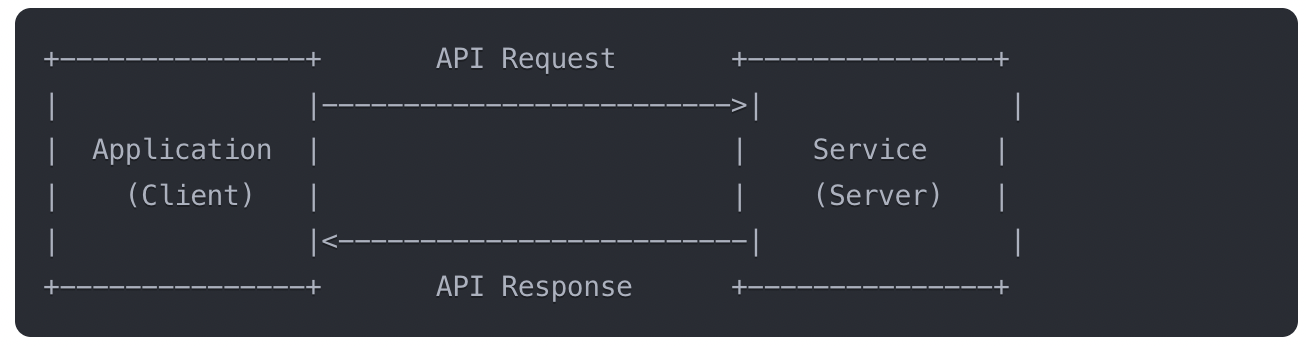
When an application interacts with an API:
- Request Formation: The client application creates a request following API specifications
- Request Transmission: The request is sent to the appropriate endpoint
- Server Processing: The receiving system processes the request
- Authentication/Authorization: The system verifies the requester has appropriate permissions
- Execution: The requested operation is performed
- Response Generation: Results are formatted according to API specifications
- Response Transmission: Data is returned to the requesting application
- Client Processing: The requesting application handles the response
Architectural Example
Types of APIs
By Access Level
Public APIs (Open APIs)
- Definition: Publicly available interfaces with minimal restrictions
- Usage: Available for use by any developer or application
- Examples: Twitter API, GitHub API, Weather APIs
- Considerations: Rate limiting, potential monetization
Partner APIs
- Definition: APIs exposed to specific business partners
- Usage: Restricted to authorized organizations with formal relationships
- Examples: Payment processing integrations, supply chain systems
- Considerations: Partner agreements, SLAs, compliance requirements
Internal/Private APIs
- Definition: APIs used exclusively within an organization
- Usage: Connecting internal systems and microservices
- Examples: Internal data services, cross-department integrations
- Considerations: Security, documentation, governance
By Implementation Type
REST (Representational State Transfer)
- Definition: Architectural style using HTTP methods to perform operations on resources
- Characteristics: Stateless, client-server, cacheable, layered
- Data Format: Typically JSON or XML
- Advantages: Simplicity, scalability, broad understanding
- Usage Example:
GET /api/products/123 HTTP/1.1Host: example.comAccept: application/json
SOAP (Simple Object Access Protocol)
- Definition: Protocol using XML for message formatting and exchange
- Characteristics: Highly structured, explicit contracts, built-in error handling
- Data Format: XML with strict schemas
- Advantages: Strong typing, comprehensive standards, rigorous validation
- Usage Example:
<soap:Envelope xmlns:soap="http://schemas.xmlsoap.org/soap/envelope/"> <soap:Body> <GetProductDetails> <ProductID>123</ProductID> </GetProductDetails> </soap:Body></soap:Envelope>
GraphQL
- Definition: Query language and runtime for APIs
- Characteristics: Client-specified data retrieval, single endpoint
- Data Format: JSON responses from structured queries
- Advantages: Precise data fetching, reduced over-fetching, type system
- Usage Example:
query { product(id: "123") { name price description inventory { inStock } }}
gRPC
- Definition: High-performance RPC framework using HTTP/2
- Characteristics: Binary protocol, strongly typed contracts, streaming support
- Data Format: Protocol Buffers (protobuf)
- Advantages: Performance, code generation, bi-directional streaming
- Usage Example:
service ProductService { rpc GetProduct(ProductRequest) returns (Product);}message ProductRequest { string product_id = 1;}
WebHooks
- Definition: User-defined HTTP callbacks triggered by specific events
- Characteristics: Event-driven, reverse communication flow
- Advantages: Real-time updates, reduced polling
- Usage Example: Notification when a payment is received or document is modified
WebSockets
- Definition: Protocol providing full-duplex communication over TCP
- Characteristics: Persistent connection, bi-directional data flow
- Advantages: Real-time data, reduced overhead for frequent exchanges
- Usage Example: Live chat applications, real-time dashboards, collaborative editing
Comparative Analysis
| API Type | Protocol | Data Format | Strengths | Limitations | Ideal Use Cases |
|---|---|---|---|---|---|
| REST | HTTP | JSON/XML | Simplicity, caching, wide adoption | Multiple roundtrips for complex data | Resource-oriented services |
| SOAP | Multiple | XML | Enterprise features, transactions, security | Complexity, overhead | Enterprise systems, banking |
| GraphQL | HTTP | JSON | Flexible queries, no over-fetching | Server implementation complexity | Mobile apps, complex UIs |
| gRPC | HTTP/2 | Protobuf | Performance, strong typing, streaming | Limited browser support | Microservices, low-latency systems |
| WebHooks | HTTP | Various | Event-driven, efficient | Complex error handling | Notifications, integrations |
| WebSockets | WS/WSS | Various | Real-time, bi-directional | Connection management | Chat, live updates, gaming |
Common Use Cases
System Integration
- B2B Integration: Connecting business systems across organizations
- Legacy System Integration: Exposing older systems to modern applications
- SaaS Integration: Connecting cloud services with on-premises systems
- Example: CRM system synchronizing customer data with an ERP platform
Mobile Application Backend
- Data Services: Providing mobile apps with server data
- Authentication: Handling user login and security
- Push Notifications: Sending updates to mobile devices
- Example: Social media app retrieving user feeds and notifications
Microservices Architecture
- Service Communication: Allowing independent services to interact
- Service Discovery: Finding available services dynamically
- Gateway Patterns: Providing unified access to underlying services
- Example: E-commerce platform with separate services for inventory, orders, and payments
Third-Party Functionality
- Payment Processing: Integrating with payment providers
- Maps and Geolocation: Incorporating location services
- Social Media Integration: Sharing and authentication via social platforms
- Example: Travel website using mapping APIs to display hotel locations
Data Exchange
- Data Aggregation: Collecting information from multiple sources
- Syndication: Distributing content to multiple platforms
- Analytics Integration: Sending data to analytics platforms
- Example: News service distributing articles to partner websites
Implementation Considerations
Authentication and Security
Authentication Methods
- API Keys: Simple token-based identification
- OAuth 2.0: Authorization framework for secure third-party access
- JWT (JSON Web Tokens): Self-contained tokens with claims
- OpenID Connect: Authentication layer on top of OAuth 2.0
- API Gateway: Centralized authentication and authorization
Security Best Practices
- TLS/HTTPS: Encrypting all API traffic
- Input Validation: Preventing injection attacks
- Rate Limiting: Protecting against abuse and DoS attacks
- IP Restrictions: Limiting access to known locations
- Sensitive Data Handling: Proper management of PII and credentials
Versioning Strategies
- URI Path Versioning:
/api/v1/products - Header-Based Versioning:
Accept: application/vnd.company.app-v2+json - Query Parameter Versioning:
/api/products?version=2 - Content Negotiation: Using Accept headers to determine version
- Semantic Versioning: Following major.minor.patch patterns for compatibility
Error Handling
- HTTP Status Codes: Using appropriate response codes (200, 400, 500, etc.)
- Error Objects: Structured error responses with codes and messages
- Idempotency Keys: Handling duplicate requests safely
- Retry Strategies: Implementing exponential backoff for failures
- Circuit Breakers: Preventing cascading failures in distributed systems
Performance Optimization
- Caching: Using HTTP caching headers or dedicated caching layers
- Pagination: Breaking large datasets into manageable chunks
- Compression: Reducing payload size with GZIP or Brotli
- Batching: Combining multiple operations in a single request
- Asynchronous Processing: Using webhooks or message queues for long-running operations
API Design Best Practices
RESTful Design Principles
- Resource-Based URLs: Using nouns rather than verbs (
/productsnot/getProducts) - HTTP Methods: Using appropriate verbs (GET, POST, PUT, DELETE)
- Statelessness: Maintaining no client state on the server
- HATEOAS: Providing navigation links within responses
- Consistent Naming: Following established conventions
Documentation Standards
- OpenAPI/Swagger: Industry standard for REST API documentation
- API Blueprint: Markdown-based documentation format
- RAML: YAML-based API modeling language
- Interactive Documentation: Allowing live request testing
- Code Examples: Providing sample usage in multiple languages
Developer Experience
- Predictable Behavior: Consistent patterns across endpoints
- Clear Error Messages: Actionable feedback for troubleshooting
- Throttling Transparency: Clear rate limit information
- SDK Availability: Providing client libraries in popular languages
- Sandbox Environment: Testing facilities for development
Real-World API Examples
Popular Public APIs
- Google Maps API: Mapping, geocoding, and location services
- Stripe API: Payment processing and financial services
- Twitter API: Social media content and interaction
- Twilio API: Communications (SMS, voice, video)
- Weather API (OpenWeatherMap): Climate and forecast data
Case Study: Twilio API
Twilio provides communication APIs that exemplify excellent design:
- Simple Interface: Clear methods for sending messages
- Comprehensive Documentation: Examples in multiple languages
- Flexible Authentication: Multiple security options
- Webhook Integration: Event notifications for message status
- Implementation Example:
// Node.js example sending an SMSconst twilio = require('twilio');const client = new twilio('ACCOUNT_SID', 'AUTH_TOKEN');client.messages.create({ body: 'Hello from Node', to: '+12345678901', from: '+10987654321'}).then(message => console.log(message.sid));
Case Study: Stripe API
Stripe demonstrates excellent developer experience:
- Consistent Design: Predictable patterns across all endpoints
- Versioned API: Clear compatibility guarantees
- Idempotency: Safe retry mechanisms for payments
- Comprehensive Events: Webhooks for all state changes
- Implementation Example:
# Python example creating a paymentimport stripestripe.api_key = "sk_test_123456789"payment = stripe.PaymentIntent.create( amount=2000, currency="usd", payment_method_types=["card"], receipt_email="customer@example.com")
Current Trends and Future Directions
API-First Development
- Definition: Designing APIs before implementing functionality
- Benefits: Better planning, clearer contracts, parallel development
- Tools: API design platforms, mock servers, contract testing
API Management Platforms
- Features: Documentation, analytics, rate limiting, monetization
- Examples: Apigee, AWS API Gateway, Kong, MuleSoft
- Benefits: Centralized control, security, observability
Emerging Patterns
- Serverless APIs: Function-as-a-Service backends for APIs
- Edge Computing APIs: Distributed API processing at network edges
- Event-Driven Architectures: Message-based asynchronous communication
- API Aggregation: Combining multiple backend APIs into unified interfaces
- Low-Code API Development: Visual tools for API creation
Future Developments
- AI-Enhanced APIs: Intelligent interfaces with built-in learning
- Semantic APIs: Self-describing interfaces with richer metadata
- Blockchain-Based APIs: Decentralized and trustless interactions
- IoT-Specific Protocols: Optimized interfaces for resource-constrained devices
- AR/VR Interfaces: APIs designed for spatial computing
Related Terms and Concepts
- SDK (Software Development Kit): Collections of tools and libraries that simplify API usage
- API Gateway: Infrastructure component that manages API traffic, security, and transformations
- Microservices: Architectural style using multiple small, specialized services connected via APIs
- API Economy: Business model centered around API provision and consumption
- Swagger/OpenAPI: Specification for describing RESTful APIs
- Rate Limiting: Restricting the number of API calls a client can make in a given timeframe
- Latency: The time delay between API request and response
- Middleware: Software that provides services to applications beyond the operating system
- Service Mesh: Infrastructure layer handling service-to-service communication
- API Monetization: Strategies for generating revenue from API usage
Conclusion
APIs serve as the critical connective tissue in modern software architecture, enabling diverse systems to communicate and share functionality through standardized interfaces. From simple internal functions to complex global services, APIs have transformed software development by promoting modularity, reusability, and integration. As technology continues to evolve, APIs will remain fundamental to innovation, enabling new business models and technical capabilities through structured, secure, and efficient information exchange.