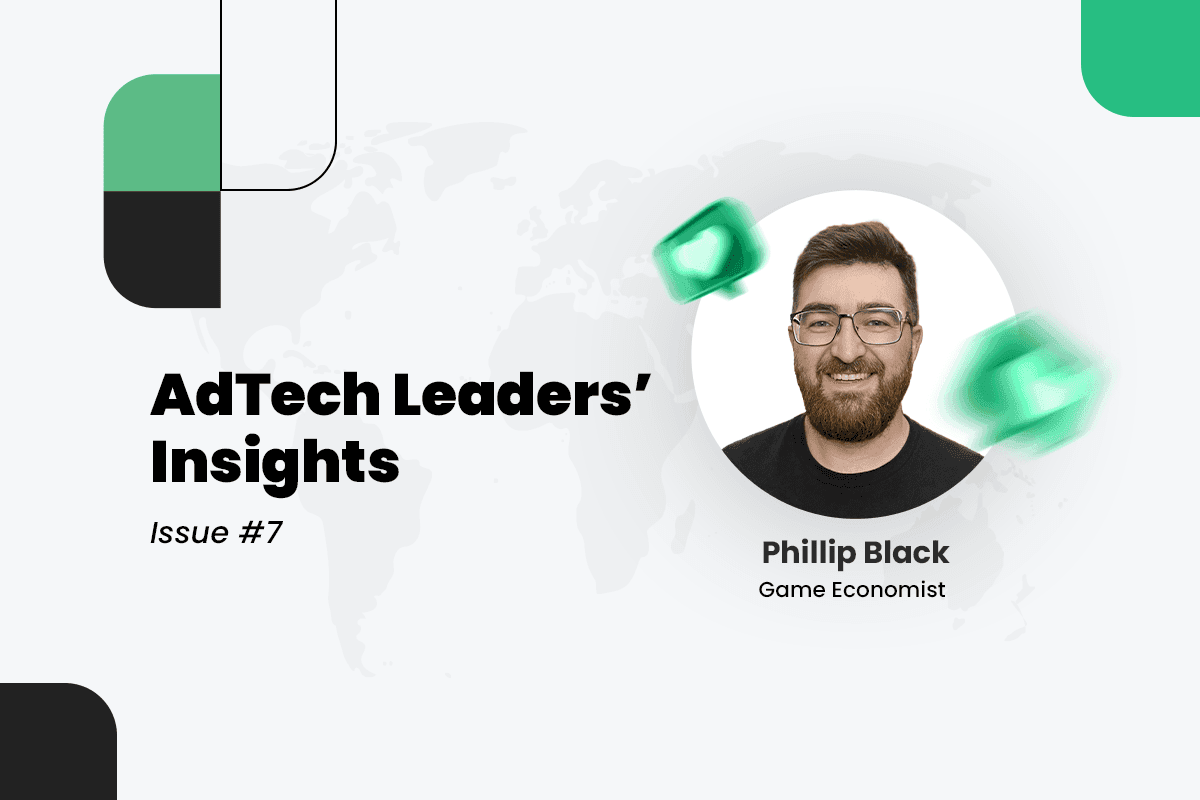
Game economics is more than monetization, it’s about understanding what players actually value, and why they pay. In this interview, Phillip Black shares his thinking on LiveOps cadence, the psychology behind F2P spending, and why most studios are running their A/B tests wrong. From the Innovator’s Dilemma in match-3 to the surprising truth behind a 10% ARPU lift, his answers are direct, data-driven, and worth sitting with.
AppSamurai: You’ve highlighted that Chinese studios are dominating Merge-2, Gossip Harbor recently overtook Candy Crush in weekly revenue. What specific economic or design advantages are giving Eastern teams the edge, and what would it take for Western studios to close that gap?
Phillip Black: Honestly, it’s been hard to spot directly. The answer appears to be just simply live ops cadence and a boatload of UA money. Based on my näive observations, I think any Western studio can compete with AI-generated assets. Many events are similar to match-3, with features like Lava Quest reappearing even after the fail state is gone, plus Merge-specific events around decorations.
Interestingly enough, one of their recurring events introduces another game board, which is normally a big no-no because it distracts from the core, versus liveops juicing the core. Given how complicated merge boards are, this approach lets devs not worry about different player states and boards.
AppSamurai: Match-3 studios like King have struggled to innovate beyond their core genre, and you’ve compared this to the Innovator’s Dilemma. If you were advising a legacy Match-3 studio today, where would you tell them to place their bets, and what should they stop doing?
Phillip Black: Well, hire me for one. Then run for the hills, second. If you asked a Kuhnian philosopher of science, they would say that if a paradigm can’t absorb new innovations, it dies. I don’t think it’s that dramatic, but growth is certainly stunted.
Look, F2P match-3 has been around for over a decade, and Candy Crush is still going strong. The genre has not died, but it’s struggled to grow. Virtually all match-3 optimization now happens on the backend, with seeds and adaptive drop. We’re starting to see merge mini-games integrated into match-3, which is some Kuhnian evidence.
User acquisition is one of the biggest challenges today; I’d focus on innovations. Where’s my Taylor Swift Liveops event? Has anyone called Oprah? For a genre that’s focused on middle-aged women, the lack of player empathy is astonishing.
AppSamurai: You argue that LiveOps is fundamentally about relevancy, capturing fleeting moments in a player’s life rather than just running events or offers. What does a mobile team’s day-to-day workflow actually look like when they start treating LiveOps through a relevancy lens and what’s the first metric or signal you’d tell them to start tracking?
Phillip Black: Pick up a newspaper. Be culturally aware from what your core audience is experiencing: again empathy. For a test: guess what the top 5 streamed shows were last month… Second is “The Madison”. How many people have seen this?
AppSamurai: You’ve pointed to slot-machine-inspired mechanics; safety nets, multiplier scaling, RNG rolls; as an underexplored design space in Merge-2. How far can casual games borrow from gambling psychology before it becomes a regulatory or retention risk?
Phillip Black: No regulatory or retention risk observed as long as you don’t do real cash payouts.
AppSamurai: Especially in Hybrid-casual games, how do you calculate the point where rewarded ads start killing IAP conversion? Is there a simple way to figure out if that video view is worth more than the potential loss of a $0.99 pack?
Phillip Black: Yes, run an A/B test. However, studios should be aware that, because spenders represent a small percentage of downloads, the statistical power and sample size you need are much higher than the retention. Test the extremes too, to affirm effect sizes. What happens if you increase the rewarded ad by 10X? What if you make it 1/10th?
AppSamurai: How do you find the balance between helping a player with a reward and keeping them hungry enough to spend? In your experience, what actually triggers a purchase: is it the high value of the gift you give them, or the fact that the player is completely out of resources at that exact moment?
Phillip Black: One key observation is how early conversion occurs in a player’s lifecycle: generally, players who will convert have done 30 days after install. Figuring out how the game’s system, UX, etc., works is expensive, despite the PM’s best efforts; however, players see that the fixed cost is amortized over long lifetimes. Think of it like a dating market where everyone’s looking to get married, and dates are expensive. That’s conversion, but ongoing purchasing? A function of the compressed time versus opportunity cost. Consider match-3 and the hard-level labeling revolution. Labeling levels as “hard” increased our ARPU by 10% (no change in difficulty!). This is an infamous experiment from King’s experimentation group, and the parable is important because players were spending to speed up progress, not just on the hard levels, but on the levels in between as well. The hard levels were a challenge players wanted to overcome, and they wanted to overcome them faster.
Mostly every free-to-play game sells time. The question then becomes: what is the value of time in the game’s economy?
AppSamurai: With the advancement of user segmentation, games can now offer ‘personalized economies’ where the price of a pack or the difficulty of a level changes based on individual player behavior. When does this “personalized economy” stop being a smart business move and start killing player trust? How do you keep the game feeling fair while still trying to maximize revenue?
Phillip Black: I disagree with the premise of the question. Price discrimination occurs everywhere, including in the airline industry, e-commerce, Uber…all around the world, too. There’s this fear that players will talk to each other and figure out that this happens. Okay, so what? In 4x games, this usually means DMing the customer service rep, trying to get the personalized offer the other player got.
Check out Phillip’s blog for more articles on game economics!