Black Friday is no longer a single day, and it is no longer mostly about gifts. Discounts start in early November, shoppers are already warmed up by October events, and most of the action now happens on a phone. For app marketers buying programmatically, that means the auction is crowded for a long stretch, not just for 24 hours.
In this guide, we walk you through how to bid, pace, and refresh creative on a DSP during the peak, with specific notes for shopping apps and finance apps.
What the 2026 data tells us about the peak
Adobe's 2026 holiday forecast, built on more than a trillion visits to U.S. retail sites, gives a useful picture of where demand will concentrate:
Black Friday is forecast at $12.9 billion in U.S. online spend, up 9.2% year over year, and growing faster than Cyber Monday because of earlier and deeper discounts on categories like TVs, apparel, and appliances.
Cyber Monday remains the biggest online day of the season at a forecast $15.1 billion, up 6.2%.
Cyber Week (Thanksgiving through Cyber Monday) is forecast at $47.5 billion, about 17% of the full holiday season.
Mobile is expected to drive a record 63% of online spend on Thanksgiving and 57.4% across the full season.
Buy Now Pay Later is forecast to drive $21.3 billion this season, with about 82% of that spend coming through mobile.
Discounts are expected to reach up to 14% in early November, up to 21% just before Thanksgiving, and up to 30% during Cyber Week, then settle at 10-15% through December.
Pre-season demand is rising too: Adobe expects October online spend to be up 8%, helped by the Prime Day event on October 6-7.
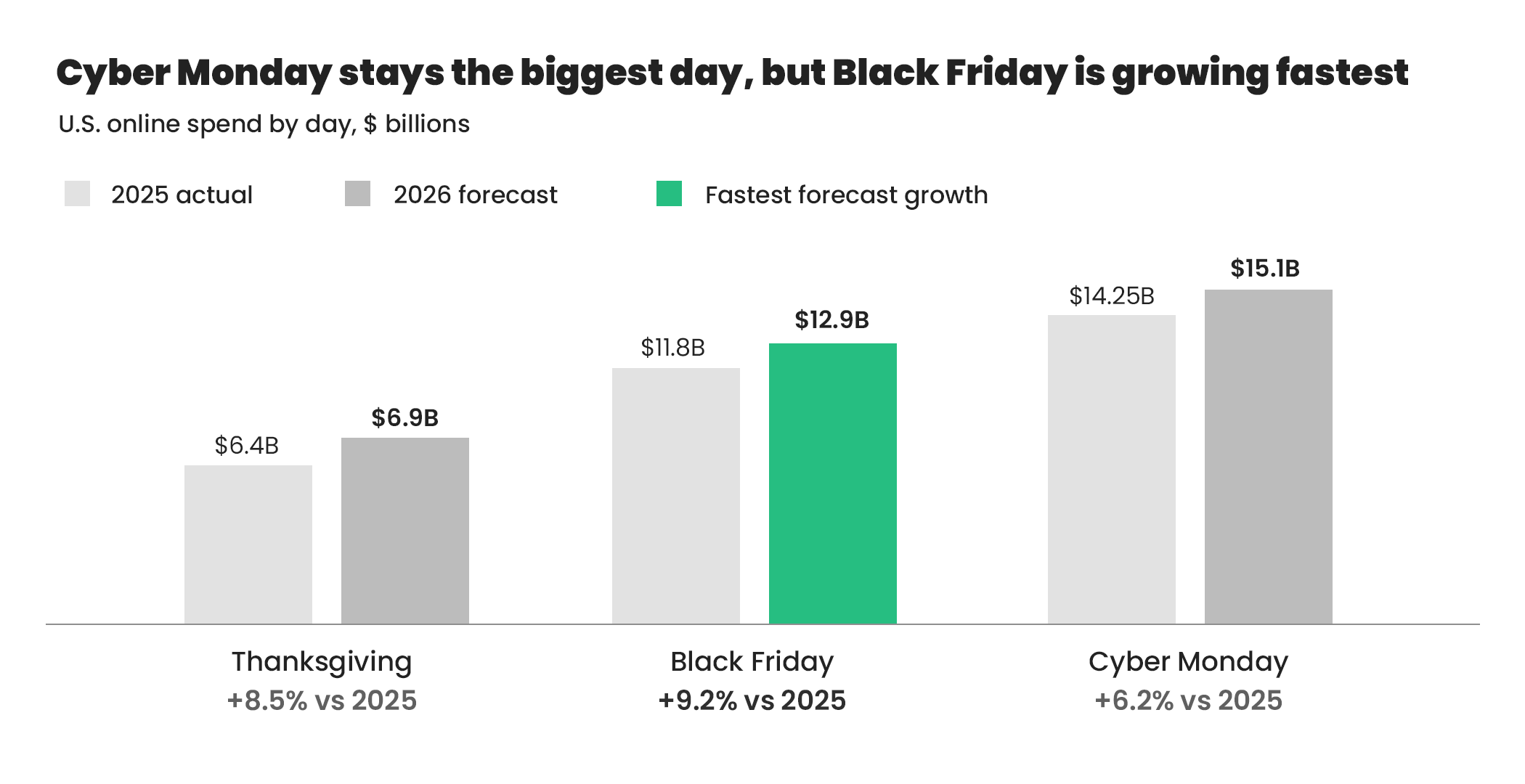
Three takeaways matter for programmatic campaigns. First, the peak is a five-day window (Thanksgiving to Cyber Monday), so splitting your budget across all five days beats betting on Friday alone. Second, mobile intent is highest on Thanksgiving and through the weekend, which is exactly where in-app inventory is strongest. Third, shoppers are using deals to stock up on essentials as well as gifts, so offer-led messaging has a broader audience than it used to.
Do CPMs really spike? It depends on you
It is tempting to plan around one universal "Black Friday CPM increase." Public estimates vary widely, and the honest answer is that pricing depends on your category, audience, geography, and creative. Tinuiti's Q4 2025 benchmark report is a good reminder: Facebook CPMs fell 13% year over year in aggregate across the advertisers it manages, yet 44% of those advertisers still saw CPMs rise. Pricing growth varies significantly by brand.
The practical conclusion: use your own account history from last November as the baseline, not an industry average. If your 2025 Black Friday week CPMs or cost per install ran well above your October levels, plan for that again. If you are new to programmatic, run a short, controlled test in the days before Thanksgiving to see where your prices land.
Bid strategy: protect value, not volume
In first-price auctions, which much of programmatic buying now relies on, you pay what you bid. During a crowded week, careless bids get expensive fast. A few principles help:
Bid to value, not to a flat number. Set higher bids for audiences that have shown purchase or deposit intent (cart abandoners, past buyers, users who started but did not finish KYC) and lower bids for broad prospecting. A single blended bid wastes money on low-intent impressions and underbids on your best ones.
Set a ceiling tied to your target cost. Decide the maximum cost per install, registration, or first purchase you can afford at your expected conversion rate. If auction prices rise and your conversion rate does not, your target cost rises with them, so cap bids rather than chasing every impression.
Segment by funnel stage. Run prospecting, retargeting, and win-back as separate lines with their own bids and budgets, so a surge in one cannot starve another.
Prioritize quality inventory. Use allowlists or performance-based supply filtering to keep spend on placements that have converted before. Peak weeks tend to attract low-quality and fraudulent traffic, so keep fraud monitoring active.
Do not over-react to hour-by-hour swings. Auction prices move constantly. Make bid changes in measured steps, and give each change enough time to show a real result.
Pacing and budget caps: the first hours decide the week
Most budget mistakes during the peak are pacing mistakes. Spend that runs out on the first morning leaves you absent when Cyber Monday, the largest day, arrives.
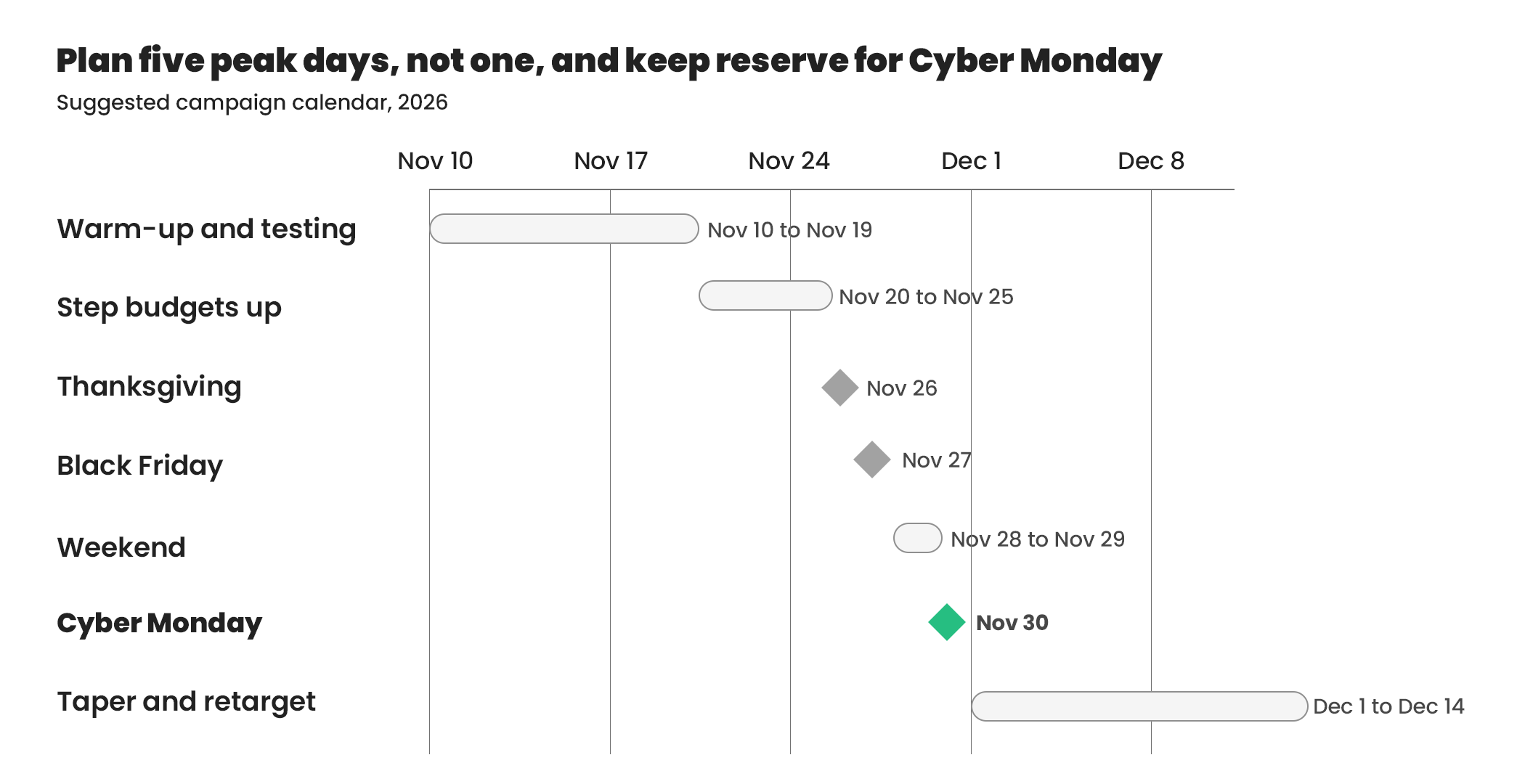
Plan by day, not just by total. Allocate your flight budget across Thanksgiving, Black Friday, the weekend, and Cyber Monday based on your own history and each day's role. Hold back a meaningful reserve for Cyber Monday.
Use daily caps with flight-level guardrails. Daily caps prevent a runaway first day. A flight-level cap makes sure the total never exceeds plan. Review both before launch.
Step budgets up, do not jump. Raise budgets gradually in the week before the peak rather than doubling overnight, so optimization has stable signal to learn from.
Add frequency caps. In a crowded week, it is easy to over-serve your best audiences. Frequency caps protect user experience and your budget.
Set alerts and decide in advance. Agree internally on what triggers a pause, a bid cut, or a budget shift (for example, cost per acquisition 25% above target for six hours), so decisions are fast and calm when the pressure is on.
Warm up early. With discounts already building in early November, the days before Thanksgiving are a chance to test creative and build retargeting pools while competition is lower.
Creative refresh: what to swap and what to keep
Creative is where holiday campaigns are often won, because every advertiser is shouting about deals at the same time. The goal is to refresh the message without throwing away what already works.
What to swap
Offers and deal messaging. Replace evergreen copy with the actual offer, discount level, and deadline.
Urgency cues. Countdowns, limited-time banners, and "ends Monday" language work well when they are true.
End cards. Make the final frame about the offer and a single clear call to action.
Dynamic product or offer feeds. For shopping apps, personalized product ads and price-drop messaging for items a user viewed tend to outperform generic banners, especially for retargeting.
Payment messaging. With BNPL driving more than $21 billion this season, showing installment options at the point of promotion can lower the barrier for higher-priced items.
What to keep
Proven layouts and formats. If a video length, aspect ratio, or layout has been your top performer, keep it and change only the message.
Brand elements. Logo, colors, and tone anchor recognition in a noisy week.
Your best-performing placements and formats. Do not swap everything at once.
How to test without losing momentum
Add new variants alongside your current winners instead of replacing them all at once. Optimization models perform best with stable signal, so rotate in two or three new concepts, watch early indicators like click-through and install-to-action rate, and retire the weakest. Start before the peak so you are not testing during your most expensive days.
The finance angle: promotions that stay compliant
Finance apps often lean on sign-up bonuses, cashback, and rate offers at this time of year. Those promotions carry disclosure rules, so build compliance into the creative workflow, not at the end of it.
In the U.S., advertising for deposit accounts falls under Regulation DD (Truth in Savings), and credit products under Regulation Z (Truth in Lending). Both rely on the idea of "triggering terms": mentioning certain specifics in an ad, such as a bonus or an APY, can require additional disclosures. For example, if an ad for a deposit account mentions a bonus, compliance guidance commonly calls for details like the time and minimum balance required to earn it and when it will be paid. Regulators have also flagged unclear promotional language about what a customer must do to earn a higher yield.
Practical steps:
Have compliance review every offer-led creative and end card before launch, including shortened versions for small ad sizes.
Make sure terms are clear and one tap away from the ad, and that the landing screen matches the claim.
Keep the offer in the ad identical to the offer in the app.
Prepare approved short-form disclosure language in advance, so you can scale creative quickly without cutting corners.
This is general guidance, not legal advice. Your compliance team and counsel should confirm what applies to your products and markets.
Measurement during the peak
With budgets moving quickly, decide in advance what you will watch each day:
Cost per key action (install, registration, first purchase, first deposit) against your ceiling.
Down-funnel quality, such as first-purchase rate, average order value, or account funding rate, not just installs. A cheap install that never converts is not a win.
Delivery health: win rate, spend versus plan, and frequency.
Creative performance: click-through and post-click conversion by concept.
Traffic quality: fraud and invalid traffic signals, which tend to rise when budgets rise.
Attribution lag. Some conversions and postbacks arrive with a delay, especially on iOS, so avoid cutting a campaign on incomplete data. Compare like with like, and look at cohorts as they mature.
A short daily review, with the same people, the same dashboard, and pre-agreed thresholds, beats constant tinkering.
After Cyber Monday: taper, do not drop
The season does not end on November 30. Adobe expects discounts of 10-15% to continue through December, and deals often carry on past Cyber Week. A sharp stop leaves value on the table.
Taper spend gradually instead of cutting to zero, and shift budget toward what performed best.
Retarget the audiences you built: cart abandoners, wishlist viewers, and users who started but did not complete an application.
Re-engage lapsed users with seasonal offers as the gifting season continues.
Capture learnings by recording which bids, creatives, and audiences won, so your December plan and next year's Black Friday start from real data.
Plan for the next peak. Mid-December brings its own surge, and teams that carry their best audiences and creative forward are ready for it.
Running Black Friday with AppSamurai DSP
AppSamurai’s mobile DSP buys app inventory in real time and uses machine learning to decide which impressions deserve your budget. It handles acquisition, retargeting, and branding in one place, so your prospecting and win-back campaigns can run side by side.
New to programmatic? A dedicated team of growth consultants can help build your bid, pacing, and creative plan before the peak hits. Talk to the AppSamurai team to get your Black Friday setup moving.