
Inside Vietnam's $1 Billion Loyalty Market: What the Growth Numbers Reveal
Vietnam's loyalty economy is one of the fastest-growing in Southeast Asia, and the numbers back it up. Market intelligence firm ResearchAndMarkets pegs the country's loyalty programs market at roughly $501.9 million in 2025, on a trajectory to cross $1 billion by 2030, a compound annual growth rate of about 14.7% through the back half of the decade, following a stretch of nearly 20% annual growth from 2021 to 2025.
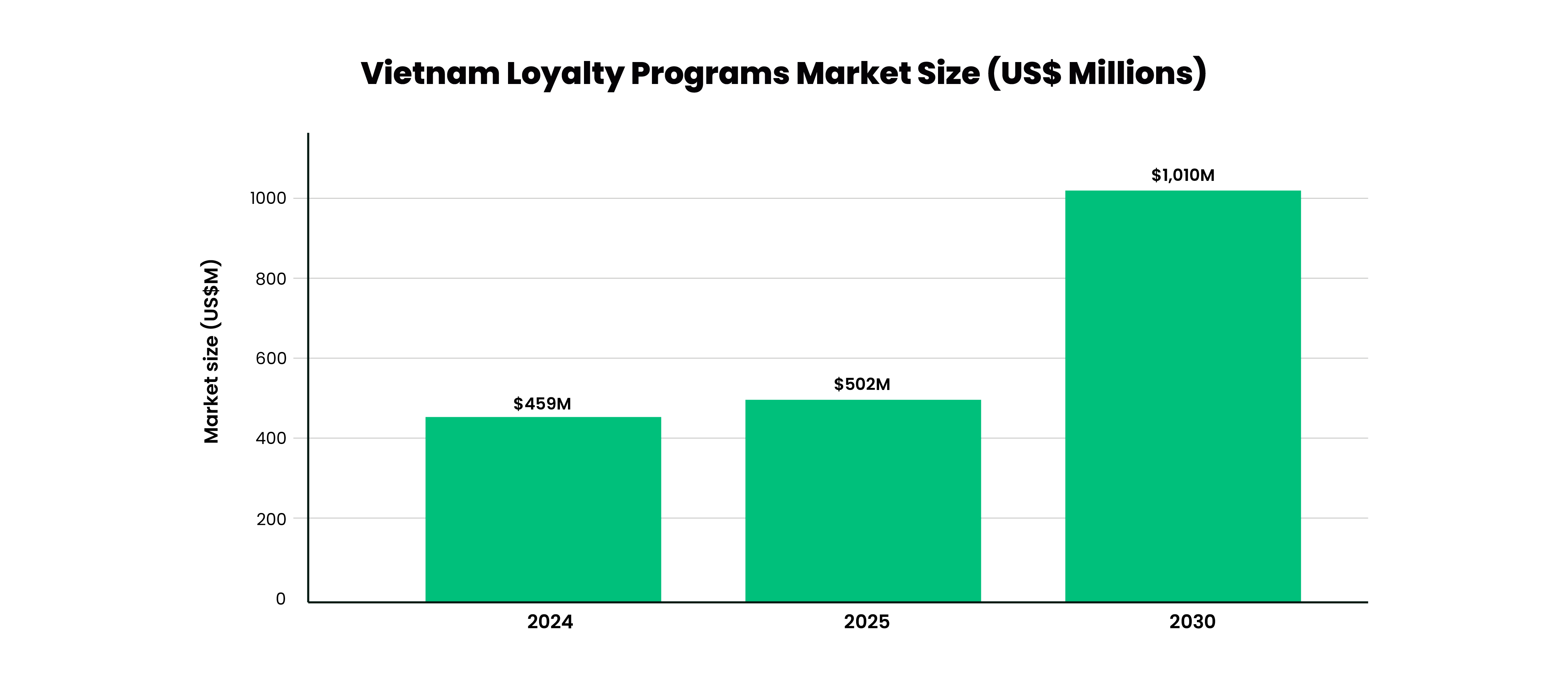
That's a market roughly doubling in size in five years, in a country where loyalty spend was under half a billion dollars just a couple of years ago. For any brand running a mobile app in Vietnam (a game studio, a QSR chain, a telco, an airline), this is the kind of growth curve that's hard to ignore.
But look past the headline number, and a more specific story shows up: almost all of that growth is still tied to purchase-triggered earning. You buy something, you get points. Spend more, unlock a tier. It's the model Vietnamese consumers already understand, and it's working, but it's also the same model retailers everywhere have been running for a decade, and it leaves an entire category of engagement (the engagement that happens between purchases) completely unmonetized and unrewarded.
What's Actually Driving Vietnam's Loyalty Boom
Three forces show up consistently across market reports on Vietnam's loyalty sector, and they're worth understanding before talking about what comes next.
Digital payments are the on-ramp. Vietnam's government has been explicit about pushing the country toward a cashless economy, and consumers have followed. Retailers have responded by folding loyalty features directly into payment flows: pay with an app, earn points automatically, redeem the same way. It's frictionless, but it's also entirely tethered to the transaction moment.
Super apps set the expectation. MoMo and ZaloPay didn't just win the e-wallet race. MoMo alone reportedly built a user base north of 30 million with roughly two-thirds e-wallet market share, while ZaloPay leveraged Zalo's massive messaging user base to build its own super app ecosystem. What matters for loyalty specifically is what these platforms trained users to expect: rewards that show up automatically from simply using the app, not from a separate punch card or program you have to remember to engage with. That expectation has quietly spread to everything else Vietnamese consumers do on their phones.
Coalition models are gaining ground. Vingroup's coalition card (letting members earn and redeem across retail, hospitality, and dining under one loyalty umbrella) is one of the clearest signals that Vietnamese consumers respond well to earning currency in one context and spending it in another. Coalition loyalty is explicitly called out in multiple market reports as a rising structure in the country, not a niche experiment.
Put those three forces together and you get a market that's sophisticated about how it delivers rewards (real-time, app-native, increasingly cross-brand) but still conservative about what triggers a reward in the first place. The trigger, almost without exception, is still money changing hands.
The Gap: Engagement That Goes Unrewarded
Here's the operational problem that gap creates. A mobile game, a telco app, an airline app, or a QSR app doesn't just want purchases, it wants daily opens, session time, feature adoption, and referrals. All of that is valuable behavior. Almost none of it currently earns anything in a purchase-triggered loyalty model, because there's no transaction to hang the reward on.
That's a missed opportunity in a market where, per the industry data cited above, gamification and data-driven personalization are already named as the two forces expected to shape the loyalty landscape going forward. Gamification implies rewarding behavior, not just spend. But most Vietnamese loyalty programs haven't fully made that leap. They've gamified the accumulation of purchase-based points (streaks, tiers, badges) without adding genuinely new, non-purchase ways to earn.
This is exactly the layer an offerwall adds. Instead of waiting for a transaction, an offerwall lets a user earn loyalty currency by completing a third-party action: trying an app, finishing a survey, watching a video, signing up for a service, completing an offer from a partner brand. The reward can be denominated in whatever currency the host app already uses: in-game currency for a mobile game, data or airtime for a telco, meal credit for a QSR chain, miles for an airline loyalty program.
The mechanics aren't new globally, offerwalls have existed in mobile gaming monetization for years. What's new is applying that mechanism specifically as a loyalty earning channel, in a market whose consumers have already been primed by super apps and coalition programs to expect frictionless, app-native rewards for engagement, not just spend.
Why Vietnam, Specifically, Is Primed for This
A few market-specific conditions make this a better opportunity in Vietnam than in many other markets:
High smartphone-first behavior. Vietnamese consumers are overwhelmingly mobile-first in how they transact and engage, which means an in-app earning mechanism like an offerwall reaches the exact surface where attention already lives, no separate loyalty app or card needed.
Consumers are already comfortable with non-cash, in-app reward redemption. Because e-wallets and payment-linked points are already the norm, adding a second earning channel (complete an offer, get points/credit/currency) requires no new behavior change on the redemption side, only a new option on the earning side.
Coalition thinking is already normalized. Vingroup's model has shown Vietnamese consumers that earning in one context and spending in another isn't confusing. It's expected. An offerwall is effectively a coalition mechanism at the advertiser level: any completed partner offer can fund currency for the host app, without the host app needing to negotiate individual partnerships the way a traditional coalition program does.
The growth is still early enough to shape. A market compounding at 15%+ annually and still years from maturity is exactly the moment to introduce a new earning mechanic, before points-for-purchase becomes so entrenched that a second model feels like a bolt-on rather than a native feature.
Where This Leaves Vietnamese App Operators
If you're running a mobile game, telco app, QSR app, or airline program in Vietnam, the market data suggests two things happening at once: loyalty spend is growing fast, and the mechanics powering that growth are still mostly limited to one earning trigger. That's an opening, not a ceiling.
Adding an offerwall as a second earning channel doesn't replace a purchase-based points program, it sits alongside it, capturing all the engagement that a transaction-only model leaves on the table. Users who aren't ready to buy can still earn. Users between purchases have a reason to keep opening the app. And because offerwall demand is funded by third-party advertisers rather than the host brand's own margin, the reward economy expands without the brand footing the entire bill.
Where Appsprize Fits
This is the specific gap Appsprize is built to close. Rather than building a custom, purchase-triggered points system and hoping engagement follows, Appsprize gives Vietnamese app operators (across mobile gaming, telco, QSR, and airline verticals) a ready-made offerwall layer that converts third-party engagement into whatever loyalty currency the app already runs on. It's a way to add a second, non-purchase earning channel to an existing loyalty program without rebuilding the program from scratch, and to do it with built-in safeguards for frequency, fraud, and reward pacing already handled.
Vietnam's loyalty market isn't short on growth. It's short on ways for users to earn that don't start with a wallet already open.