

The basis of any business is to generate income. Without income, it is challenging to maintain a long-term project. So how do you make money from a free mobile app? How can revenue be generated?
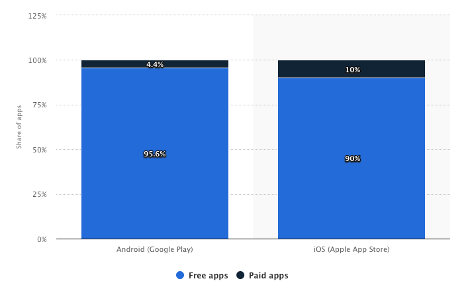
This graph shows the distribution of paid and free download applications on Google Play and the App Store. As we can see, more than 90% of the applications are free to download. They are free to download but not 100% free; they simply use other methods to generate income, techniques that we will see below.
Earn money with an application with micropayments
As we said, an application can be downloaded for free, but it does not mean that it cannot earn income.
An application can offer certain premium features once the user is inside. In other words, certain functionalities that are only obtained if the user pays for them. We have absolute freedom to create these so-called micro-payments within our application. Within these integrated payments, we have to differentiate between two types. The first is a one-time payment. It is a payment that the user has to make only once and already manages to unlock that premium functionality.
Let’s imagine an application that allows you to edit photos and apply different effects. Perhaps these effects could be premium, and you would have to pay for them to be able to apply them. Once the user bought the filter, they could use it at any time. You don’t need to buy it over and over again.
The second type of micropayment is just the opposite. It’s a payment that is made every time that premium functionality is needed.
One of the most classic examples is that of games and extra life packs. Let’s imagine a game where we need a series of lives to be able to play and that, once we finish them, we have to wait a specific time to play again. The ideal option offered by these games is to buy more lives.
However, once we buy and spend these lives, we have to buy more if we want to keep playing. We could say that these micropayments have an expiration date.
As payment applications have been losing popularity, micropayments have been gaining it. Especially a type of micropayment that we are going to separate here into a new category: subscriptions.
Earn money with an app with subscriptions
If today there is a particularly booming method in the software world, this is a subscription.
Subscriptions are nothing more than a recurring type of micropayment. Usually, the applications that offer subscriptions are free to download, but in order to access certain features, you need a subscription, that is, to pay recurrently every X time. In most cases, this period is monthly.
Services like Netflix or Spotify have helped popularize this type of income method. In fact, today, it is rare to find someone who is not signed up for any recurring service.
Make money with an app with ads.
We are viewing paid applications, micropayments and subscriptions. Is there any other type of income method left?
Yes, perhaps the most popular of all, the applications with ads.
In all the previous cases, the income comes directly from the user. It is the user himself who pays the application with his money. However, there is a way to earn income without costing the user money, and it is through third-party ads.
If we have advertisers who are interested in paying to leave within our app, we can charge for that space. This can be done in two entirely different ways.
Make money with ad networks.
The first is to resort to ad networks calls. The ad networks are companies engaged in contacting developers and advertisers. As creators of the application, we only have to configure where and
when we want to show these ads, and the ad network will do the rest of the work.
In fact, I am sure that you will already know which is the largest ad network in the world today, Google. The Mountain View company is, through its Adsense products for the web, and Admob for mobile applications, the largest advertising company on the Internet. Coincidence that Android is owned by Google and that it is free? I don’t think so ????
Make money with your own advertisers.
The second option is to sell the space ourselves. Contact advertisers and set the price ourselves. This means that we will have to manage the payments, the types of ads that we will show, the analytics and reports to customers everything.
There are many applications that use this method of income today. Perhaps, by apps monetized through ads, a small application developed by an independent creator that has the typical banners and full-screen ads could come to mind. In any case, there are other applications that we use every day, much more significant, that also fits perfectly in this category. We are talking about apps like Facebook, Twitter, Youtube or LinkedIn.
In fact, when we use this type of application, we believe that we do it for free, only due to the fact that we can download and use it without having to pay a Euro, but the truth is that we are paying for the service. We are paying, not with money, but with our information.
All the personal information that we transfer to these applications is then used by these companies to sell advertising space to their advertisers. And the truth is that nothing goes wrong for them. Information is a big business today. Using an ad network has the great advantage that we don’t have to worry about getting advertisers or dealing with them. In fact, we can have ads in our app in an hour.
Also read -> https://appsamurai.com/9-ways-to-make-money-from-free-apps/
The problem is that the income will be lower since these companies will keep a percentage of them in exchange for all the service and the platform they offer us. On the other hand, if we decide to manage advertisers ourselves, we may be able to earn more, but we will also have to take care of managing advertisers.
Could not generate text at this time.
…users to edit photos for free but offers advanced filters or exclusive editing tools for a small fee. This is a classic example of the “freemium” model, where the app provides a solid base of free features to attract users and then tempts them with premium offerings to enhance their experience. The beauty of this approach is that users feel in control—they can enjoy the app without spending a dime or choose to invest in extras that truly elevate their experience. Think of it as window shopping turned interactive! It’s a win-win: users get to explore the app risk-free, and developers have a steady stream of potential revenue from those willing to pay for added value. Whether it’s unlocking new levels in a game, accessing exclusive content, or removing pesky ads
…users to edit photos with basic features for free, but to access advanced tools like AI-powered filters or high-resolution exports, they need to make a small one-time payment. This model, often referred to as a “freemium” approach, is especially popular because it allows users to experience the core value of the app without any upfront cost. Once they see its potential, many are willing to pay a little extra for enhanced features that elevate their experience. It’s like getting a taste test before committing to the full meal. App developers love this strategy because it creates a win-win scenario: users get to try before they buy, and developers earn revenue while building long-term trust and loyalty. So, the next time you use a free app, keep