Rewarded Playtime
Engage, Retain, Monetize in Mobile Gaming
How rewarded playtime works, the regional data behind it, genre-by-genre campaign strategy, and the KPIs that separate winners from underperformers. Built for growth teams scaling casual, hybrid-casual, and mid-core games.
Rewarded Playtime Handbook
Introduction
How rewarded playtime matured into a foundational pillar of mobile UA and retention.
How It Works
The dual-value loop, the three reward pillars, and the player / advertiser / publisher angles.
Genre-Specific Landscape
How casual, hybrid-casual, and mid-core games monetize, and where rewarded playtime fits each.
Regional Landscape
Monetization and reward behavior across the US, South Korea, Japan, Brazil, and Europe.
Trends & IAPs
The shift to player value, channel diversification, and the data behind rewarded playtime.
Best Practices & Campaign Strategy
Designing reward experiences, setting goals, segmenting audiences, and optimizing rewards.
Measuring Performance
The five KPIs that tell you whether a rewarded playtime campaign is actually working.
The Mobile Gaming Landscape & Rewarded Playtime
From experimental tactic to foundational cornerstone
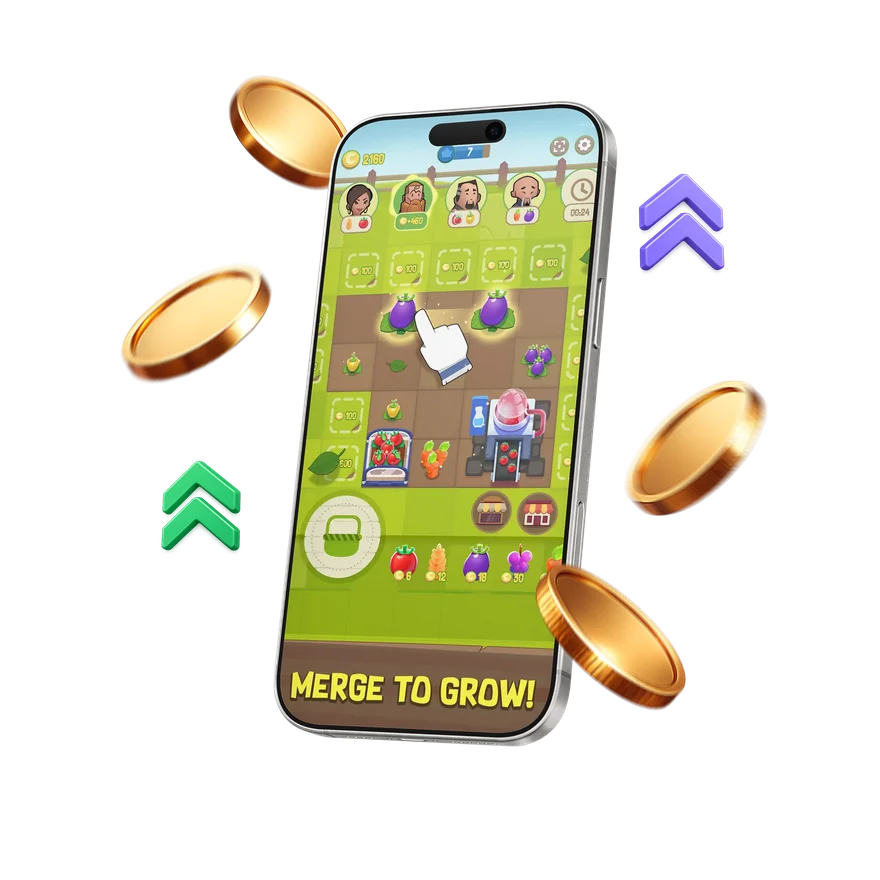
Far from a passing novelty, the model has built a long-term track record of driving sustainable growth. Four findings make the case:
Powerful First Impressions
In Almedia’s Rewarded Returns global study, 72% of players say real-world rewards are a critical factor in their decision to install and try a new game.
Extended Player Longevity
The same study finds 71% of players lengthen their sessions because of incentives, and 85% keep playing a title regularly even after a specific reward campaign has ended.
Organic Amplification
Rewarded systems turn players into advocates: over 76% are highly likely to recommend a rewarded game to their communities, fuelling cost-effective word-of-mouth in a saturated market.
Long-Term Connections
The Mistplay Mobile Gaming Loyalty Index aligns with this: nearly half of mobile gamers (49%) stay loyal to a favorite title for more than a year, and 42% of those refer three or more friends across their lifecycle.
One model, two sides of the market
By paying players in coupons, gift cards, or cash for the time and effort they invest, rewarded playtime creates a profitable ecosystem for both sides of mobile publishing.
For Publishers & Developers
A high-intent acquisition channel. As AppsFlyer reports hybrid monetization adoption climbing from 36% to 43%, this format turns added engagement directly into deep-funnel events, deeper level progression, and statistically stronger in-app purchases.
For Monetization-Focused Platforms
A niche, entirely non-intrusive ad format that maximizes ad equity. By trading tangible, predictable value for player time instead of interrupting with jarring interstitials, platforms lift sustained ad revenue and retention at the same time.
Rewarded Playtime: How It Works
The dual-value loop
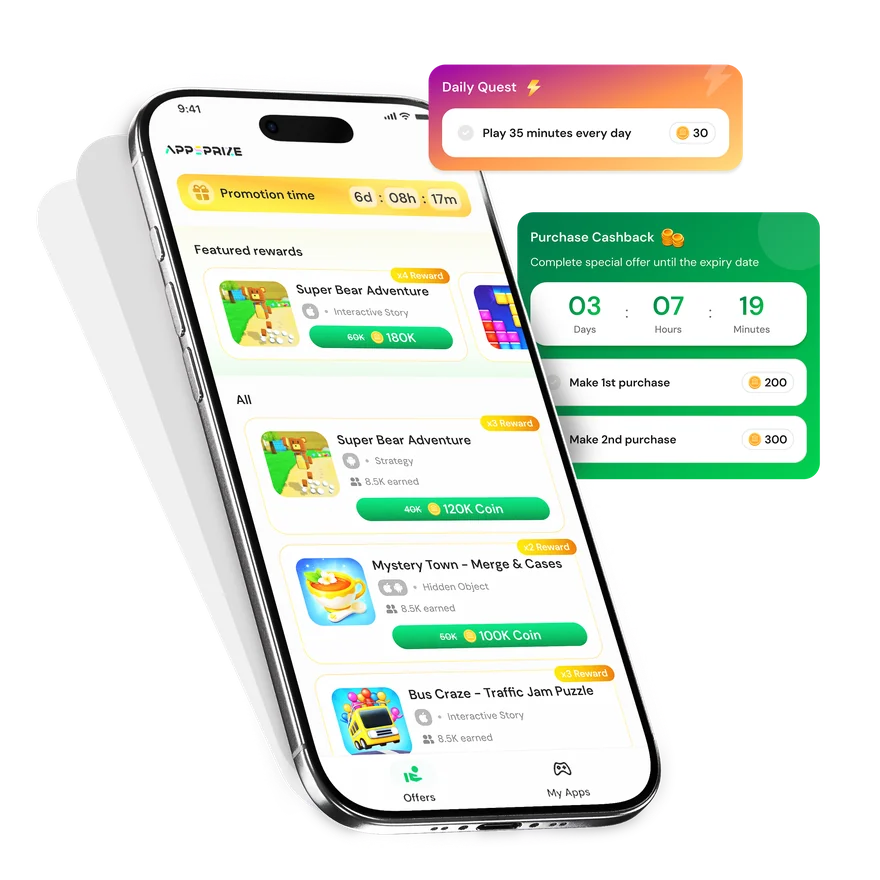
Modern platforms have retired physical incentives like paper coupons and checks in favor of instant digital payouts driven by SDK or API integrations. Rewards are tracked seamlessly and distributed across three pillars of player progression:
Time-Based Accumulation
Players earn platform currency or reward points tied directly to the playtime they log inside an app: the longer they play, the more they bank.
Granular Milestone Achievements
Hitting specific milestones or completing designated levels unlocks premium tiers: digital gift cards, cash-back perks, or exclusive in-game assets.
Deep-Funnel Actions
High-value payouts trigger when players reach significant achievements or show consistent engagement over a longer period: the signals that correlate with real LTV.
The cornerstone of every campaign
Rewards have to be perceived as valuable. That perception is what motivates players to keep engaging across different games.
The Three Angles of the Ecosystem
To grasp the scale of the model, view it through its three core participants: the player, the advertiser, and the publisher.
The Player
Value for engagement
The Advertiser
High-intent user acquisition
The Publisher
Retention & sustainable monetization
Value for Engagement
For the user, the value proposition is frictionless. Players opt in voluntarily and pick titles they genuinely want to play. They earn real-world payouts (gift cards or digital cash) and crucial in-game rewards like premium currency, rare items, or progression boosters. That dual structure satisfies two distinct needs at once: immediate gratification inside the game, and tangible financial value outside it.
High-Intent User Acquisition
Developers have two strategic alternatives, depending on whether the goal is to aggressively scale acquisition or to maximize their game’s internal economy.
Outbound User Acquisition
Placing your game on publisher sites. You act as the advertiser buying high-value traffic, listing your title inside a rewarded platform, offerwall, or publisher app to attract fresh players.
How it operates: users browsing a partner app see your game listed alongside specific rewards, then download and engage to earn them.
Strategic value: because payouts are tied to milestone completion, you pay only for users who cross key depth thresholds (finishing a tutorial, reaching Level 70) for a reliable, optimized ROAS.
Inbound Economy Optimization
Integrating the offerwall into your own game. You act as the host, using rewarded architecture as a premium monetization and retention system inside your own ecosystem.
How it operates: you embed a rewarded playtime offerwall in your UI; active players open the panel, browse partner apps or tasks, and opt to try them.
Strategic value: instead of disruptive video ads or a hard paywall, players earn your premium currency for free by spending time elsewhere, lifting goodwill, bridging non-payers to premium content, and adding a diversified ad-revenue stream without hurting retention.
Retention & Sustainable Monetization
Monetizing the Non-Spender
Most mobile players never make a direct cash purchase. The rewarded framework lets these users earn premium in-game content by cleanly directing their time toward tasks in partner apps.
Elevated Lifetime Value
Giving players a reliable alternative to opening their wallets (while keeping the game ad-undisrupted) raises satisfaction, lengthens sessions, and adds a dependable, diversified ad-revenue stream.
Genre-Specific Landscape & Monetization Dynamics
Where rewarded playtime fits each genre

1. Casual Games
Royal Match · Monopoly GO! · Candy Crush Saga
Monetization: driven mainly by IAPs (extra lives, boosters, event tokens), supplemented by calculated in-app advertising.
The fit: casual players are motivated by progression, so milestone rewards keep them engaged through natural plateaus and nudge them toward becoming paid spenders.
2. Hybrid-Casual Games
Survivor.io · Stumble Guys · Block Blast!
Monetization: a balanced 50/50 split of IAA and IAPs, leaning on rewarded video, battle passes, and micro-subscriptions.
The fit: these titles depend on engagement milestones to trigger ad revenue and pass sales, making rewarded playtime an ideal funnel for high-retention, value-exchange-savvy users.
3. Mid-Core & Hardcore Games
Clash of Clans · Genshin Impact · PUBG Mobile
Monetization: overwhelmingly high-value IAPs (gacha mechanics, character and item customization, cosmetic skins, and seasonal battle passes).
The fit: these games suffer steep early churn. Incentivizing players past the initial learning curve (reaching Level 10, finishing a tutorial) sharply scales their organic LTV and propensity to purchase.
Market Revenue Breakdown by Genre Group
Global consumer-spend distribution reflects a mature market where casual and hybrid mechanics claim the lion’s share of engagement. Source: Sensor Tower & Statista.
| Product Model / Genre Group | Core Monetization Focus | Revenue Share Trend | Core Player Motivation |
|---|---|---|---|
| Mid- & Hardcore | Deep IAP, gacha, cosmetics | Stable / high spender concentration | Strategy, competition, status |
| Casual | Core IAP (boosters, lives), light IAA | Steady annual growth | Relaxation, quick progression |
| Hybrid-Casual | Hybrid (balanced IAA + meta IAP) | High growth / scaling ad equity | Milestone achievement, upgrades |
| Hyper-Casual | Pure IAA (interstitials, banners) | Declining share (ad fatigue) | Immediate entertainment |
The Shift from Ad-Volume to Player-Value
As ad-signal loss and rising CPIs reshape the industry, developers have moved away from chasing raw install volume. Success now belongs to studios that diversify channels and build loyal user bases. Rewarded playtime is the bridge across every genre, delivering high-intent players who explore deep gameplay loops and maximize both ad equity and long-term IAP profitability.
Regional Landscape: Global Monetization & Reward Behaviors
Five markets, five very different playbooks

iOS & Google Play; excludes third-party Android in China and other markets. Source: Sensor Tower.
🇺🇸 United States & North America
High-value saturation & content fatigue
The US is a mature, fiercely competitive ad ecosystem where legacy formats face distinct monetization hurdles.
The Revenue vs. Ad-Spend Mismatch
Ad spend is crowded into Casual (Lifestyle & Puzzle) at a 56.2% share, yet that category generates only 41.3% of IAP revenue. Action & Strategy capture 34.8% of IAP revenue on a lighter 30.7% ad-spend share.
Genre Shifting
In 2025, Strategy led North American growth, scaling IAP revenue by $1.12 billion, with a $604 million lift in Puzzle. Older mechanics contracted hard: Casino revenue fell $860 million.
Age & Gender Profiles
The casual and hyper-casual base skews older. Nearly 60% of players are 35+. Gender splits sharply: Lifestyle (77% female), Puzzle (63%), and Tabletop (62%) against Shooters (72% male) and Strategy (73% male).
Annual Trends for Mobile Games by Product Model: United States
Because US casual ad delivery has consolidated into high-attention video (53.7%) and playable (13.3%) formats, creative fatigue sets in fast. An outbound rewarded playtime model captures the high-intent, mature female audience (35+) looking for clear progression hooks, without forcing intrusive interstitials on them.
🇰🇷 South Korea
Deep player stickiness & hardcore dominance
South Korea is one of the most lucrative, high-penetration mobile markets on earth: the fourth largest, with 24 million active mobile gamers.
The Playtime Multiplier
Top-grossing Korean games average 119 minutes of daily playtime, an engagement rate 4 to 5 times higher than standard vertical averages.
RPG Sovereignty
RPGs command 47% of total market revenue at $3.17 billion. Google Play captures 79% ($2.49 billion) of that, though iOS RPG revenue is on pace to expand over the next few years.
Strategy & Casual Openings
Strategy generates $716.6 million, drawing an older male audience at 45 minutes a day. Casual leads raw popularity with 177 million downloads, driven by female players logging 45 minutes daily, double the global casual baseline.
South Korean Mobile Revenue by Genre (2024)
Regulatory Layer & Compliance
Publishers must design around strict frameworks: local law mandates full disclosure of drop and draw probabilities across all card, gacha, and loot-box mechanics, and foreign game entities are legally required to designate an official local representative for compliance, or face stiff financial penalties.
Because Korean players are driven by achievement and competition, F2P acquisition relies on demonstrating authentic, high-quality gameplay. An inbound rewarded playtime offerwall is the ideal way to monetize non-spending users, especially on Android, where casual ad monetization already accounts for 13.7% of total revenue ($18.8 million) and keeps expanding.
🇯🇵 Japan
Maximizing outsized LTV via targeted meta-layers
Japan mirrors South Korea’s high-LTV concentration, leaning on deeply synchronized monetization systems rather than high download volumes.
The Store Revenue Paradox
Unlike US casual ad clutter, Japan inverts the pattern: Action & Strategy generate the overwhelming majority of store IAP revenue while accounting for a surprisingly low share of outbound paid ad spend.
Live-Ops Breakouts
Engagement rebounded on the back of massive domestic live-ops. Breakout titles like SD Gundam G Generation ETERNAL dominated domestic charts, generating exceptional revenue per day right at launch.
Hybrid-Casual IAP vs IAA Revenue Share: Japan
Japanese users show low tolerance for disjointed, low-clarity ad creative. Outbound acquisition wins here when it uses deep performance milestones (reaching a complex meta-progression tier, for instance) that match the high-intensity preferences of the local player base.
🇧🇷 Brazil & Latin America
High-volume ad landscapes
Anchored by Brazil’s scale, Latin America is an essential volume powerhouse for international growth, with distinct structural monetization dynamics.
Ad-Monetization Dominance
A volume-first, heavily Android ecosystem. Within hybrid-casual, ad revenue from rewarded video and interstitial placements provides the foundational monetization layer for publishers.
Emerging Growth Vectors
Strategy expanded its regional footprint with an $84 million revenue lift in 2025, alongside a steady $73 million increase across Puzzle sub-genres.
Mobile Game Class Ad-Spend Share vs IAP Revenue Share: Brazil
With direct cash-based IAP conversion sitting lower than in Tier-1 nations, inbound offerwall systems thrive across Latin America. Letting players download outbound advertiser titles to earn premium virtual currency in their core domestic game safely monetizes non-paying users’ time, without running into hard localized paywalls.
🇪🇺 Europe
The hybrid progression model
Europe has emerged as a resilient driver of IAP growth, with strong upside across Western territories despite flat download volumes.
Geographic Variations
In-app purchase health varies intensely by country. The United Kingdom strengthened its position markedly, France stayed entirely flat, and Germany ran into soft monetization headwinds.
The European Genre Surge
Europe posted the industry’s biggest Puzzle gains, an outsized $706 million IAP lift, with Royal Match taking the top regional spot and Gossip Harbor the largest net uplift. Strategy also expanded by $629 million.
Because European casual portfolios face intense content fatigue, top publishers are testing sophisticated milestone-based events. Paid access to accumulated rewards (mini-passes without free tracks that build value through engagement) has delivered an average 18% release-revenue impact across European cohorts, aligning neatly with strict local data-privacy expectations.
Regional Performance Matrix
Where marginal ad spend maps to the highest deep-funnel conversion potential, by region and genre.
| Region | Strategy IAP Shift | Puzzle IAP Shift | Casino IAP Shift | Key Monetization Vector |
|---|---|---|---|---|
| North America | +$1.12B | +$604M | −$860M | High ad-spend share on Casual |
| Europe | +$629M | +$706M | +$140M | Strong progression / live-ops focus |
| Asia | +$1.38B | +$321M | −$99M | Dominant core RPG & 4X strategy spend |
| Latin America | +$84M | +$73M | −$5M | Android ad-network volume capture |
Mobile Gaming Trends & Rewarded Playtime
The rising importance of in-app purchases

In-app purchases (from progression boosters to cosmetic items) remain the primary engine of revenue. Rewarded playtime feeds that engine directly by keeping players engaged long enough to form deep gameplay habits.
The 5× Conversion Rule
Players who accumulate 600 minutes (10 hours) of playtime during their first week are five times more likely to convert from free users into direct IAP spenders.

IAPs have become even more important for hypercasual game publishers, offering a more reliable revenue stream. By partnering with reputable incentivized UA platforms, we can reach a wider audience and attract players more likely to make in-app purchases.
Mert Şimşek, Co-founder & CMO at APPS
A crowded market needs a different channel
With more than 84,000 active mobile game advertisers in the market (a 21.9% year-over-year surge), traditional methods have become crowded, expensive, and exposed to severe signal loss. Developers need alternative channels to attract and retain players efficiently.
Rewarded playtime offers a genuinely different approach. Rather than dropping users into random, disruptive placements between levels, it uses a game’s own progression mechanics, backed by monetary rewards, to build a loyal base and create organic buzz. Players deliberately opt in from dedicated loyalty spaces with a clear intention to engage, which not only encourages high-intent players to start but securely scales their long-term retention and lifetime value.

Signal loss, rising CPIs, and the reality that traditional UA channels alone no longer cut it are driving a shift from high-volume user acquisition to high-value player experiences. Marketers who diversify channels and explore alternatives like rewarded ads will achieve sustainable growth.
Peggy Anne Salz, Mobile Analyst & Content Marketing Strategist
The Data Surrounding Rewarded Playtime
- •33% of spenders say they’ll spend on an IAP deal too good to refuse, and 40% spend more when they receive personalized offers.
- •79% of players take part in loyalty programs, and 51% spend more in-game in exchange for extra points or monetary rewards. (Mistplay)
- •In AppSamurai rewarded playtime campaigns, 76% of acquired players completed multiple in-game tasks, with a 24% uplift in D2 retention.
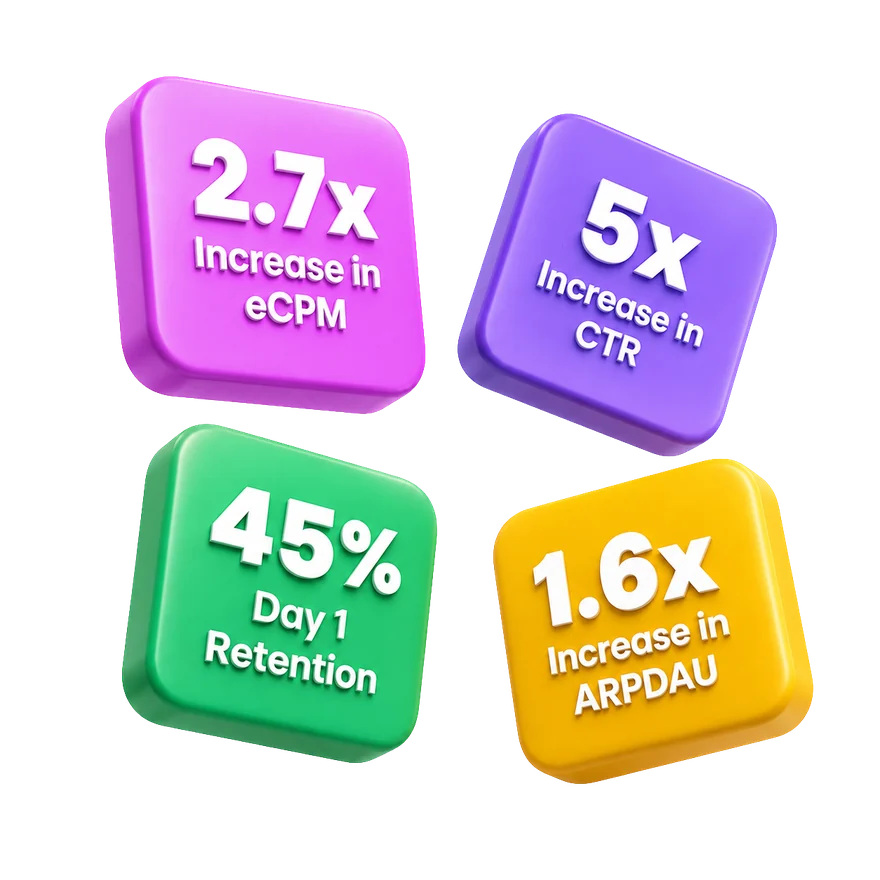
eCPM Increase
CTR Increase
ARPDAU Increase
Day 1 Retention
Best Practices & Campaign Strategy
Designing rewarded playtime experiences
Uninterrupted User Experience
Because players opt in voluntarily, rewards fit naturally into gameplay. An undisturbed experience lifts satisfaction, encourages longer sessions, and retains players who would otherwise be put off by intrusive ads.
Tiered Reward System
Reward players incrementally: small gift cards or discounts for early levels, scaling to larger cash prizes and coupons at major milestones. Each tier creates a sense of progression that pulls players toward the next.
Reward Player Investment
Match reward value to effort. Completing challenging levels, joining special events, or reaching specific milestones should trigger higher-tier payouts, so players feel their time and skill are genuinely recognized.

The key to an effective campaign strategy lies in understanding the user journey and delivering value at the right moments. Coupled with thoughtful audience segmentation and ongoing data-driven adjustments, a rewarded playtime campaign can drive higher session time, increase retention and LTVs, and deliver a higher overall ROAS.
Faheem Saiyad, Director at AppSamurai
Campaign Strategy Pillars
Campaign Goals & Objectives
Set specific, measurable goals up front. A retention campaign prioritizes rewards for daily logins and longer sessions; an IAP campaign offers incentives for purchases made during the campaign window.
Target Audience
Combine demographics (age, location, spending habits) with behavioral signals like in-game preferences and progression. Newer players respond to small, frequent rewards; seasoned players prefer larger, milestone-based ones.
Reward Optimization
A/B test reward types and values to find the balance that maximizes engagement and ROAS: digital gift cards versus cash-back, or small frequent rewards versus larger, less frequent ones.
Competitive Analysis
Monitor competitor campaigns for reward strategies and player responses. If a rival offers high-value rewards behind a complex redemption flow, you can win by matching the value with a far simpler claim process.
Measuring & Analyzing Performance
The five KPIs that matter
Player Engagement
Session length, DAU, and WAU. Longer sessions signal players are more immersed because of the rewards; rising DAU and WAU mean more players are engaging consistently.
Lifetime Value (LTV)
Average revenue per player across the full engagement period. A higher LTV shows rewards are driving sustained interaction and in-app purchases, not just a short-term spike.
Retention Rates
D1, D7, and D30 return rates. Strong retention indicates the model is effectively encouraging players to come back; weak rates flag where the loop is leaking.
Return on Ad Spend (ROAS)
Revenue measured against ad spend. ROAS reveals which campaigns and reward structures are most profitable; a low figure points to optimizing placements, bidding, or targeting.
Event Completion Rates
How rewarded playtime moves players through specific in-game events. Comparing the highest and lowest completion rates lets you tune reward offerings to each event’s difficulty and appeal.
Frequently Asked Questions
Ready to Launch a Rewarded Playtime Campaign?
Our growth team has scaled 500+ apps with rewarded UA across every major region. Tell us about your game, and we’ll design a campaign strategy around it.
Talk to Our Growth Team →